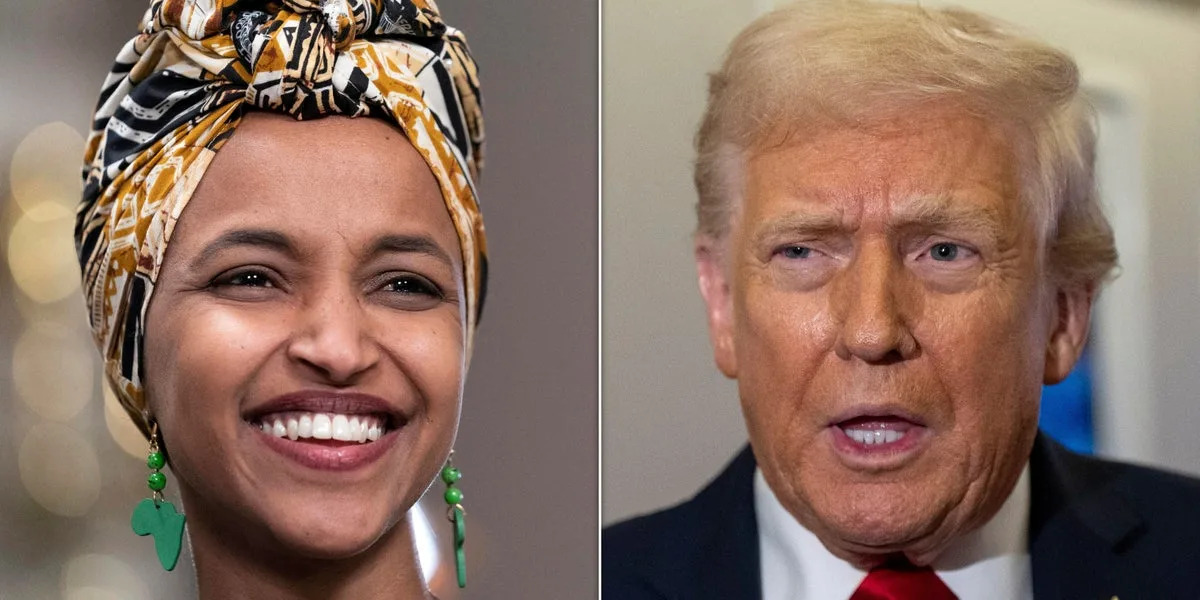
Yesterday, US President Donald Trump described Somalia as a “fourth world nation” and repeated unproven claims about Congresswoman Ilhan Omar, alleging she had married her brother to enter the United States.
Omar has publicly called the allegations “sick,” yet the statements circulated widely, dominating both news coverage and social media discourse. What is particularly striking is that these comments came from the office of the most powerful country in the world, a position that traditionally carries responsibilities for measured communication, diplomatic credibility, and the projection of national leadership.
Trump’s history demonstrates a consistent pattern. In prior years, he has used derogatory language to describe African nations, including referring to some as “shitholes,” and has repeatedly targeted Somali-American communities and Somali-born politicians. He has told critics to “go back” to their countries of origin, even when those individuals were American citizens.
In less than two months, he also shared a video depicting former President Barack Obama and former First Lady Michelle Obama in demeaning caricatured imagery, a post he attributed to another creator raising questions about the propagation of racially charged content by someone in his position. These instances suggest a pattern in which provocative, dehumanizing, or racially coded communication is normalized within his public messaging.
The persistence of such rhetoric can be traced to several factors. Trump’s communication style has long relied on confrontational engagement, which energizes a core audience and frames him as unbound by conventional political norms. Media amplification and social feedback loops reinforce this dynamic, giving visibility and attention to statements that might otherwise be marginalized. Politically, the lack of direct repercussions within his support base may further reduce perceived risks, creating conditions under which escalation feels not only permissible but strategically advantageous.
This approach, however, has consequences. Communities directly targeted such as Somali-American populations, experience social stigmatization and reputational harm. Broader public trust in norms of discourse is challenged when language from the highest office merges personal attack, racialized imagery, and international insult.
From a historical perspective, few modern US presidents have employed this combination of personal, national, and racialized denigration publicly and repeatedly. The norm has been to confine criticism to policy or governance, not to blend geopolitical judgment with personal attacks on individuals’ identity or background.
The implications are significant. Observers are left to examine how power, identity, and rhetoric interact in contemporary political communication. Questions arise about accountability, the boundaries of acceptable presidential discourse, and the potential normalization of rhetoric that dehumanizes entire communities. Whether one interprets these actions as politically calculated, performatively aggressive, or racially motivated, they demand close scrutiny for their effects on both domestic cohesion and international perception.
Ultimately, what unfolded yesterday is part of a broader pattern in which provocative speech and personal attacks are used as instruments of influence and narrative control. Understanding this pattern requires both knowledge of Trump’s prior conduct and attention to the structural conditions, media ecosystems, political incentives, and audience reception that allow such rhetoric to persist with minimal immediate consequence.


















 Politics8 hours ago
 Politics8 hours ago



 Politics7 hours ago