From a Nigerian musician’s ambitions for football to a Rwandan boy’s restored eyesight, the 2026 Ballon d’Or offered several ways to understand Africa’s place in the global game.
Africa’s presence at the 2026 Ballon d’Or ceremony in London was visible in several forms: through Burna Boy’s cultural influence, Bukayo Saka’s humanitarian work, the story of a Rwandan child who regained his eyesight and the African players included among the nominees.
These moments were connected by the ceremony, but they represented different realities. Together, they showed both the reach of African talent and the distance between visibility and influence in global football.
A Nigerian ambition on a European stage
Before presenting the Socrates Award, Burna Boy spoke about the football academy he established in Nigeria. He said he hoped to return to the Ballon d’Or one day and see a player from his country receive the sport’s most coveted individual prize.
That ambition points to a longstanding reality. Africa has produced players who have shaped European football, won major competitions and become global stars. Yet Liberia’s George Weah remains the only African winner of the men’s Ballon d’Or, having received the award in 1995.
The gap between Africa’s supply of talent and its representation among football’s highest individual honours remains difficult to ignore. Burna Boy’s remarks focused attention on the work required to close it, particularly through investment in youth development and stronger football structures at home.
His presence also reflected the global reach of African culture. A Nigerian musician stood at a ceremony centred on European football and spoke not only as an entertainer, but as someone investing in the sport’s future in Nigeria.
A boy in Rwanda enters the conversation
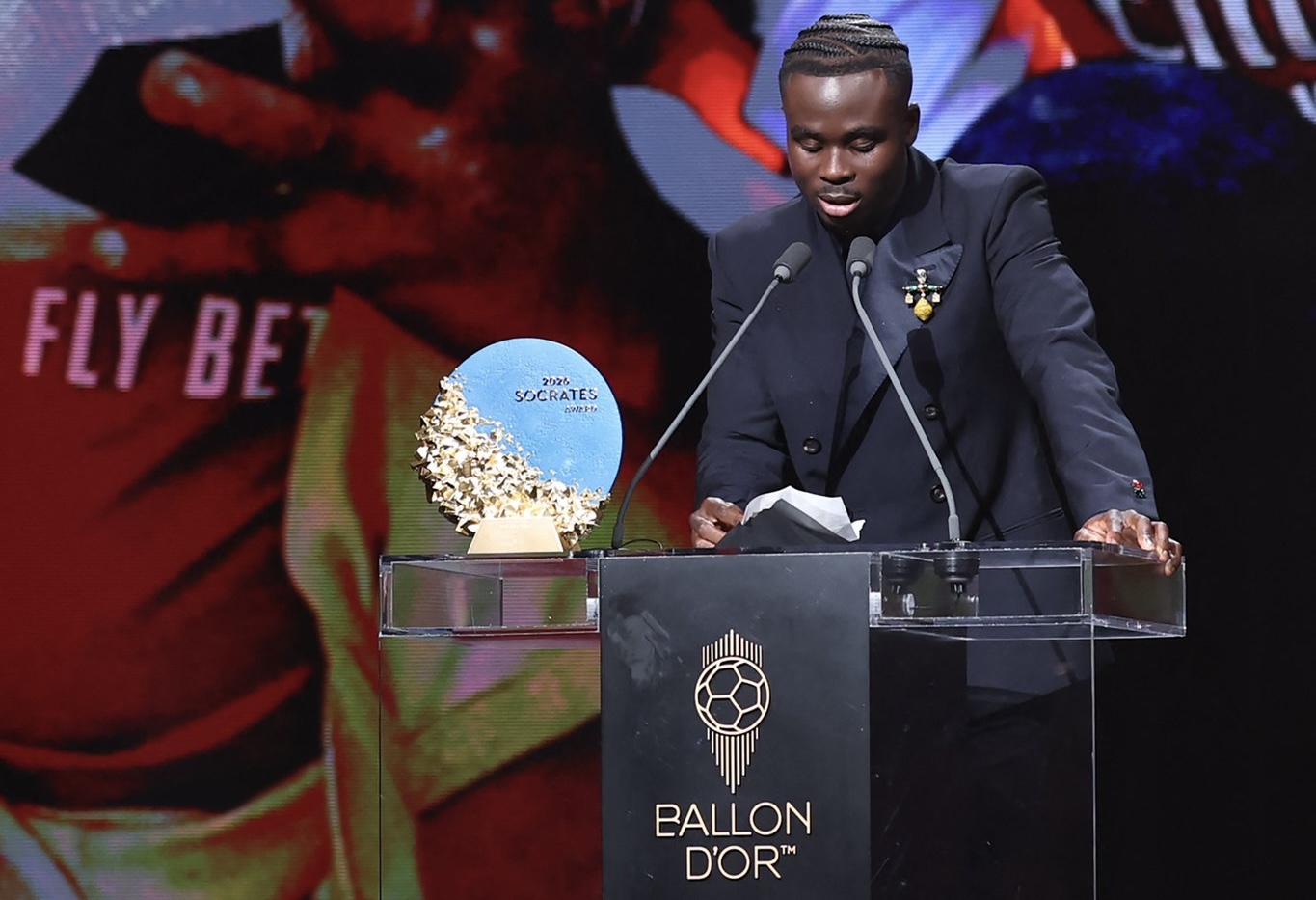
Saka’s acceptance speech brought the ceremony’s humanitarian dimension into sharper focus. He read a letter from Byiringiro, a boy from Rwanda who had begun losing his eyesight at the age of 12.
Byiringiro described living in a village without electricity and struggling as his vision deteriorated. In the classroom, he could no longer read the blackboard clearly.
Medical care facilitated by BigShoe helped restore his eyesight. He could read again, play with his friends and pursue his ambition of becoming an English teacher.
The significance of that story lies in its ordinariness. Byiringiro wanted to learn, play and choose a profession. Medical treatment helped return those possibilities to him.
Saka’s humanitarian work has supported medical treatment for children in Africa, including operations for 120 children in Kano, Nigeria, in 2022 and support for another 100 children in Rwanda, Kenya and Tanzania in 2023. The Socrates Award recognised that work, while Biringiro’s letter showed its impact through one child’s experience.
His story also raises a broader issue. International attention can bring visibility to a child’s circumstances, but it does not resolve the wider shortage of accessible healthcare. Many other children still face preventable conditions without the treatment they need.
Byiringiro’s recovery is hopeful. It also shows how access to healthcare can determine the future a child is able to imagine.
The players whose names carried African flags
Africa’s presence extended across the ceremony’s football categories.
Morocco’s Achraf Hakimi and Senegal’s Sadio Mané were nominated for the men’s Ballon d’Or. Zambia’s Barbra Banda and Malawi’s Temwa Chawinga featured in the women’s race. Morocco’s Ayyoub Bouaddi, Côte d’Ivoire’s Yan Diomandé and Algeria’s Ibrahim Maza were nominated for the men’s young-player award. Morocco’s Yassine Bounou, Senegal’s Édouard Mendy and Cape Verde’s Vozinha were among the goalkeeper nominees.
Their inclusion reflected different aspects of African football. Hakimi and Mané represent established careers at the highest level. Banda and Chawinga brought African women’s football into a global conversation that has historically focused more heavily on men. The young-player nominees represented a generation whose careers will develop across national, continental and international competitions.
Nominations, however, are not victories, and representation is not the same as equal recognition. Harry Kane won the men’s Ballon d’Or, while the African players competed in their respective categories.
The significance of these nominations does not depend on presenting them as proof that African football has finally arrived. African football has long been part of the global game. The more important questions concern how its achievements are recognised and whether the structures supporting its next generation are strong enough.
The ceremony brought together several distinct stories: Burna Boy’s vision for Nigerian football, Saka’s support for children needing medical care, Byiringiro’s recovery in Rwanda and the presence of African players across the nominees’ lists.
Together, they showed Africa’s place in global football as more than a single narrative. The continent appeared through cultural influence, sporting ambition, humanitarian work and the lives affected by that work.
But visibility does not automatically create influence. African music has achieved global reach, and African players compete at the highest levels. African children can also benefit from international charitable partnerships. Sustaining those achievements requires long-term investment in local football, stronger opportunities for young players, wider access to healthcare and recognition that reflects the quality of African talent.
The Ballon d’Or cannot resolve those issues. It can make them visible.
For one evening in London, Africa was represented by a Nigerian musician, a footballer with Nigerian roots, nominees from across the continent and a Rwandan schoolboy whose eyesight had been restored.
Byiringiro wants to become an English teacher. He does not need to become famous for that ambition to matter. He needed medical care, received it and can now see the blackboard again.
That may be one of the clearest measures of football’s influence: not only the trophies won on stage, but the opportunities made possible for people who will never stand there.
















 Entertainment2 days ago
 Entertainment2 days ago

 Business2 days ago

 Sports2 days ago

Max
February 27, 2026 at 11:15 pm
Wow this is so unfortunate